

The price of a new home isn’t the full cost of building it. Florida impact fees can add a separate charge before residential construction begins, with the amount varying by property, home, and local fee schedule.
We want you to know about that charge before you buy a lot or settle on a floor plan. A parcel-specific estimate gives you a better starting budget than an online average.
Key Takeaways
- Impact fees are one-time charges for public facilities needed because of new development. They aren’t charges for construction labor or materials.
- Florida law governs fee justification, increases, credits, and notice, including a statutory cap and phase-in limitations. The parcel’s jurisdiction and the charging local government or special district determine the amount and payment details.
- A fee shown on an older county chart isn’t a reliable quote for your permit. Confirm the amount and who pays it in writing before you commit to a lot or contract.
What Florida Impact Fees Pay For
When a community grows, it may need more road capacity, school space, parks, or emergency-service facilities to meet infrastructure needs. A local government, school district, or special district may charge a development impact fee to help fund qualifying growth-related public facilities.
The charge is generally assessed once for new development. It isn’t a recurring property tax or a building permit fee. Permit fees support permitting work; impact fees address the additional demand a project places on public facilities.
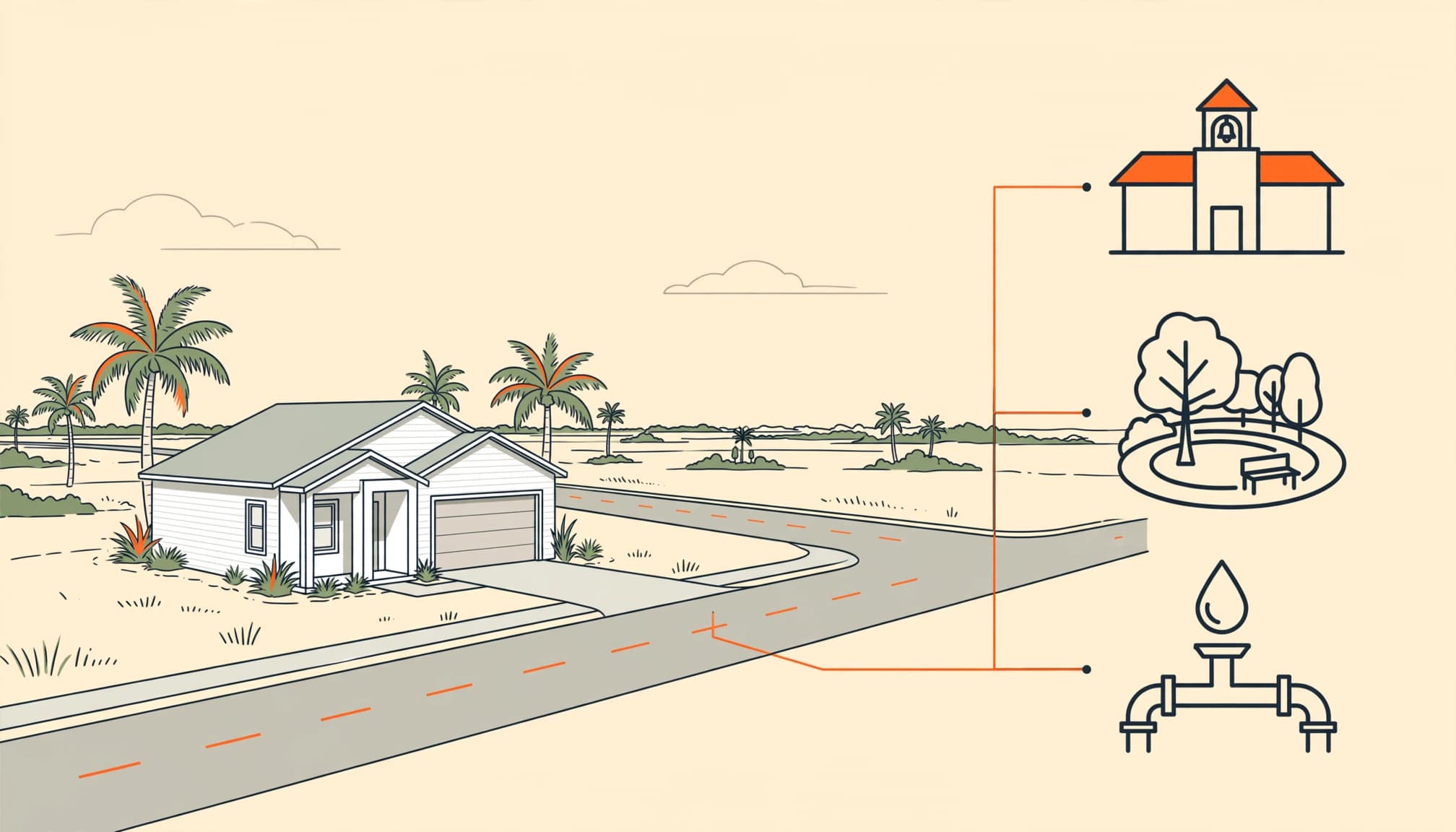
For your budget, keep impact fees apart from site clearing, fill, utility connections, and construction. Each may appear at a different stage. Grouping them under “building costs” makes it harder to see what’s included in a builder’s price and what remains your responsibility.
A new home may benefit from public facilities without every fee appearing on one county invoice. A special district or another authority may assess fees on the same parcel, so we recommend checking every charging authority that applies to the address.
How the Florida Impact Fee Act Protects New Construction
Florida doesn’t set one statewide impact-fee price. The Florida Impact Fee Act (the impact fee act), in section 163.31801 of the Florida Statutes, sets requirements for a local government or special district imposing charges for public facilities and capital facilities.
Fees Need a Demonstrated Connection to Growth
A demonstrated-need study must show a need for capital facilities. It must use the most recent localized data available within four years of a fee update.
The law also requires a rational nexus. In plain terms, a charge must connect new development to the need for added facilities and the benefit that development receives. This rational nexus means impact fees can’t become general money for unrelated expenses.
That doesn’t make every household’s calculation identical. The adopted study, fee schedule, and classification of the proposed home determine the assessment.
Notice and Accounting Matter, Too
Authorities must give at least 90 days’ notice before a new or increased impact fee takes effect. An ordinance or resolution adopts the charge, while a statutory cap and phase-in limitations may constrain increases.
The statute also addresses permit applications submitted before the effective date, so the application date matters when a rate changes.
For fees adopted or increased after July 1, 2026, the law requires separate accounting for collections and expenditures. These rules help you see when a charge changes and how the money is handled.
How Much Can Impact Fees Increase?
The ordinary statutory cap is an increase of no more than 50% of the current rate, with increases generally limited to once every four years. That statutory cap limits the schedule, not the amount one home can be charged.
The Phase-In Depends on the Size of the Increase
The phase-in limitations require a rate increase of 25% or less to be spread across two equal annual increments. For a rate increase above 25% and up to 50%, the phase-in limitations require four equal annual increments.
For a buyer, the practical question is which rate will apply when the permit application is submitted. A proposed fee increase isn’t automatically the amount due on a project already in permitting.
Ordinary Growth Isn’t Automatically Extraordinary
Florida law allows increases beyond the usual limits only in extraordinary circumstances. Approval requires a qualifying study, at least two publicly noticed workshops, and a two-thirds vote by the governing body, such as a county commission or special district board. A vote alone doesn’t establish extraordinary circumstances or justify the increase.
In Attorney General Opinion AGO 2026-01, the Florida Attorney General concluded that Nassau County’s 17% population growth over five years didn’t qualify as extraordinary circumstances. Population growth can create real demand for facilities, but steady growth alone doesn’t establish an exception to the limits.
How Transportation and School Fees Are Calculated
Two fee categories can appear on the same new-home estimate, but they fund different public facilities. A local government or special district may set the schedule, and a special district may collect the charge. There isn’t one calculation used by every Florida county or school district.
Transportation Fees Address Road Capacity
Transportation impact fees are based on studies estimating added travel from new development and the cost of providing road capacity. The adopted schedule then assigns charges to development types. A detached home and a commercial building won’t necessarily be assessed the same way.
Road charges may also depend on the local service area or schedule. We wouldn’t use a neighboring county’s road fee to price a lot, even if the floor plan is identical.
School Fees Address Student Capacity
School impact fees relate to the added student capacity expected from residential growth. Supporting studies can consider student-generation rates and the cost of providing school facilities. School impact fees aren’t simply a fixed percentage of the home’s sale price.
The classification matters here, too. Before using a published figure for a duplex, confirm whether the authority assesses each unit separately and which residential category applies. That answer belongs in your written project estimate.
Why County and City Schedules Need a Closer Look
Southwest Florida offers a clear reason to check the address first: Lee, Charlotte, and Highlands counties publish different materials. A property inside a city may involve different charging authorities than one in an unincorporated area, including a local government or special district. Separate charges from a special district may also apply.
A Lee County fee table dated May 2023 listed a $9,996 base road fee for a detached single-family home, with $5,248 collected at the table’s 52.5% collection rate. It also listed collected school and parks components of $2,879 and $806, plus a 3% administrative fee on impact-fee assessments. Those figures illustrate a published schedule, not a current quote for a 2026 permit.
Charlotte County’s impact-fee information identifies the public facilities funded by its charges and points readers to its schedule. Highlands County’s impact-fee materials include its study and fee documents. Schedules differ, so use official sources to confirm the rates currently adopted and payable for the parcel’s jurisdiction. Check the authority’s current schedule, as adopted by ordinance or resolution, not only the date printed on a study.
If you’re considering a Cape Coral lot, don’t assume an unincorporated Lee County example covers it. Confirm the parcel’s jurisdiction, applicable school impact fees and district charges, and any separate city fees before comparing lots.
When Impact Fee Credits Can Reduce a Charge
Credits can matter when a developer has already contributed land, built a qualifying improvement, or paid for growth-related capacity. Impact fee credits aren’t a general discount available to every new-home buyer.
Florida law permits qualifying impact fee credits to be assigned or transferred between developments or parcels within the same zone or district. An adjoining zone or district in the same jurisdiction may also qualify if the receiving property benefits from the contribution, consistent with the rational nexus requirement.
A seller’s claim that a lot “has credits” isn’t enough. The available balance and its use on your proposed home need written confirmation.
For a lot purchase, ask the county, city, or special district charging the fee to verify any impact fee credits, including their type, balance, and transfer requirements. Confirm the seller can convey the credit and whether it applies on a dollar-for-dollar basis under local rules. Until confirmed, we wouldn’t subtract it from the project’s estimated fees.
How Impact Fees Affect Land Value
Impact fees don’t disappear because a builder pays them first. They remain part of the cost of delivering a finished home. Depending on the contract and market, that cost can affect a builder’s price, an investor’s return, or what a buyer can afford to pay for land.

Builders Work Back From a Finished-Home Budget
A developer considers the expected value of completed homes, then accounts for construction, site work, financing, fees, and other project costs before deciding what land is worth to the project. That approach is often called residual land value.
Higher impact fees can leave less room for the land purchase price. This matters when comparing parcels in different jurisdictions or deciding whether a smaller home or duplex makes financial sense.
Buyers Should Compare Lots on Total Cost
A lower-priced parcel isn’t always the better value. One lot may need more fill, drainage work, or utility connections. Another may carry different public-facility charges.
In land transactions, compare the lot and the costs to build on it together. An investor should also confirm the fee classification for every planned unit before setting an offer price or estimating a return.
When to Confirm the Fee Before Permitting
Fee timing deserves attention if a local authority has announced an increase. A proposed change may be subject to a statutory cap, but that cap doesn’t determine an individual home’s fee. Required notice gives you time to check the effective date, but it doesn’t replace a review of your permit package and application status.
Permit timing also depends on complete plans, reviews, revisions, inspections, and project complexity. The current rules of the local government or special district responsible for your parcel, along with your permit-application date, determine the applicable rate and payment timing. Don’t assume that choosing a floor plan fixes the rate that will apply later. Ask how the rules apply to your proposed submission date.
Keep the answer with your other project records. Orange County’s impact-fee guidance, for example, directs applicants to its Impact Fee Administration for a project estimate. For a Southwest Florida build, make the same request to the authorities responsible for your parcel.
Build a Budget Without Hidden Fee Surprises
A dependable new-home budget shows government charges as separate line items. We want you to compare a builder’s proposal with the local estimate, not discover a missing charge after financing is arranged.
Request Numbers for the Actual Parcel
Contact the local government or special district that administers fees, and use its official rate schedule. Give the relevant office the property address or parcel number, proposed home type, number of units, and expected permit timing. Ask for current rates, schedules, payment timing, and applicable exemptions or credits, including any affordable housing exemption. Confirm whether a pending change could affect the project and what public facilities the estimate covers.
Then confirm permit fees, utility connection charges, special assessments, and site-work costs separately. None should be treated as an automatic part of the impact-fee quote.
Put Payment Responsibility in Writing
Your construction agreement should say who obtains the permit, who pays each impact fee, whether the amount is included in the contract price, and what happens if it changes. If a seller promises transferable credits, document that separately.
We can help you bring the lot, floor plan, and budget into the same conversation. You can discuss your new home project with our team when you’re planning a build in Lee, Charlotte, or Highlands County.
Frequently Asked Questions
Are Impact Fees Included in a Builder’s Price?
Sometimes, but never assume they are. Ask for a written list of included and excluded charges. If the builder pays them, confirm whether that cost is already in the contract price or billed separately.
Are Impact Fees the Same as Permit Fees?
No. Impact fees help fund qualifying public facilities needed for growth. Building permit fees pay for permitting services and follow the applicable authority’s fee schedule. Your project may owe both.
Can a County Raise Fees by More Than 50%?
Not through the ordinary increase process. Florida law sets a 50% statutory cap on a standard rate increase, not on an individual home’s total assessment. A separate, demanding process applies to extraordinary circumstances. Regular population growth alone doesn’t automatically meet that test.
Can Impact Fee Credits Move to Another Lot?
Qualifying credits may transfer within the zones allowed by Florida law when the receiving property benefits. Confirm the balance, location, and approval requirements with the charging authority, such as a county, city, or special district, before relying on a transfer.
The Right Number Starts With the Right Lot
A new-home price makes more sense when you can see what’s behind it. Confirm impact fees for the actual parcel with the local government, including the current amount and any applicable exemption. Rates can vary by city or county, so put payment responsibility in writing and keep these costs separate from permits and construction.
That preparation helps you choose a lot and a home plan with a budget you can trust.