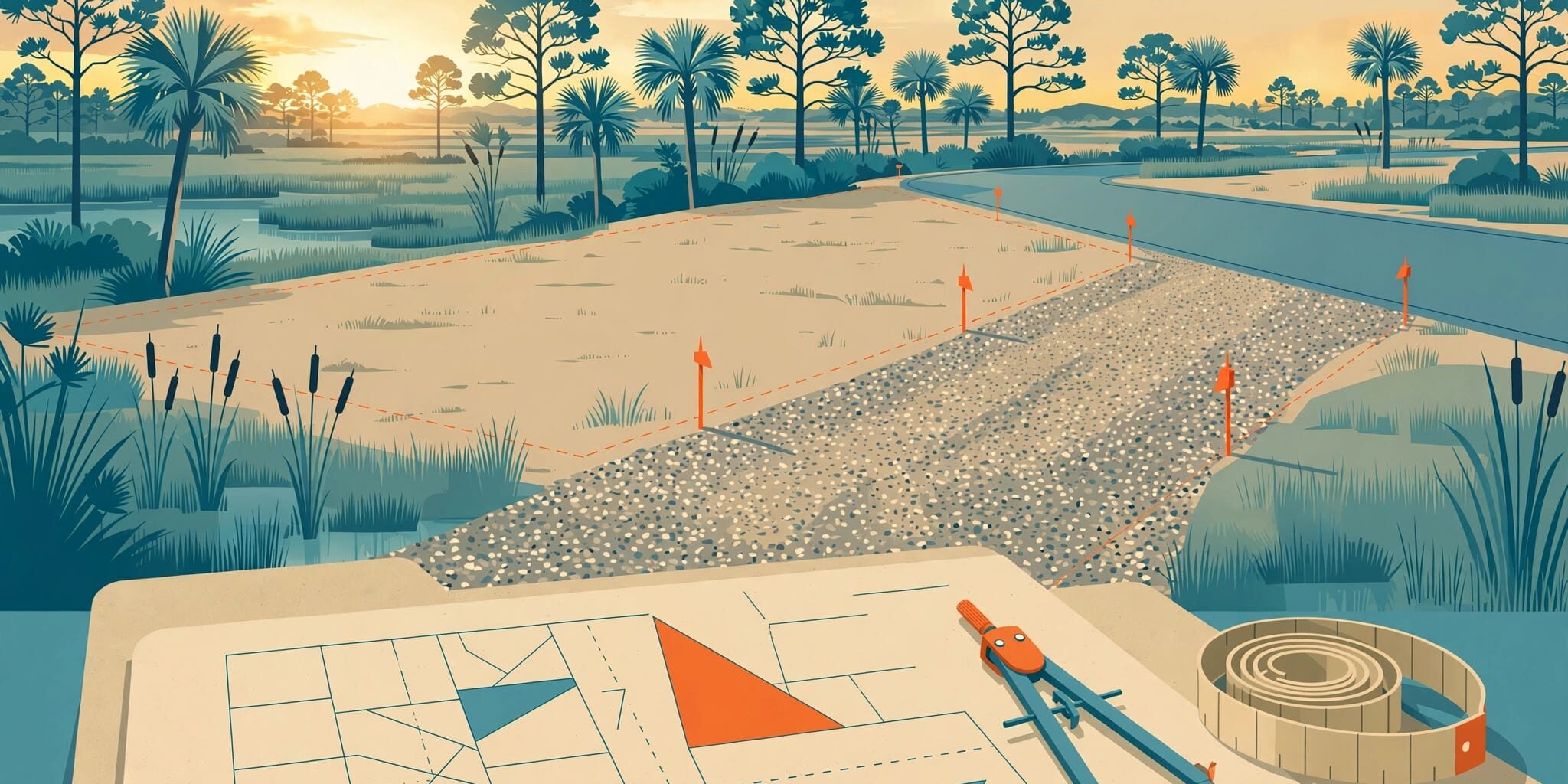
Physical access is what you can see, while legal access is the right to use a route. Recorded access appears in the title or public records. A driveway, dirt trail, or neighbor’s verbal permission may show physical or historical use, but none proves Florida lot access or a transferable property right. Without a documented route, you could buy a landlocked property.
Before estimating construction or land clearing costs, compare the deed, title commitment, survey, and plat. Check county public records and site conditions as well. For Central Florida lot buyers, a clear access plan protects your budget and build schedule. It also supports property value and resale prospects.
What Legal Access Means for a Florida Building Lot
Legal access means a documented right of ingress and egress to a public right of way. That right may come from a public street, private road, or recorded property instrument.
The key word is documented. A route visible from the lot may cross private land, wetlands, or a utility corridor.
Public Right-of-Way vs. Private Roads
A public right of way is land reserved for public travel and maintained by a government agency. Your lot may front a county road, city street, or platted public street.
Private roads are different. They may be owned by an HOA, several landowners, or one neighboring parcel. Confirm ownership, user rights, gate restrictions, maintenance duties, and emergency-vehicle access through recorded instruments and applicable county or municipal records.
A recorded easement may establish access, while historical deeds can reveal access reserved in prior conveyances. An easement by necessity may provide a legal theory for a landlocked property, but it isn’t the same as having a ready-to-use recorded corridor.
A Visible Driveway Is Not Proof
Many buyers see a physical driveway, dirt trail, or old access route and assume legal access is settled. That can be a costly assumption, especially in Central Florida, where routes may cross private land or environmentally sensitive areas.
The seller may have used the route with a neighbor’s verbal permission. Permission can be withdrawn, and it doesn’t create a recorded right that transfers with the lot.
Legal access is a property right, not a convenience based on past use.
Start With Florida Lot Access Records
Start early, while your offer can still include a due-diligence period and clear contingencies. Order a county title search, current deed, title commitment, and current survey to evaluate legal access. Public records provide the first picture, but they don’t confirm that a route is physically usable.
Match the Parcel to Its Legal Description
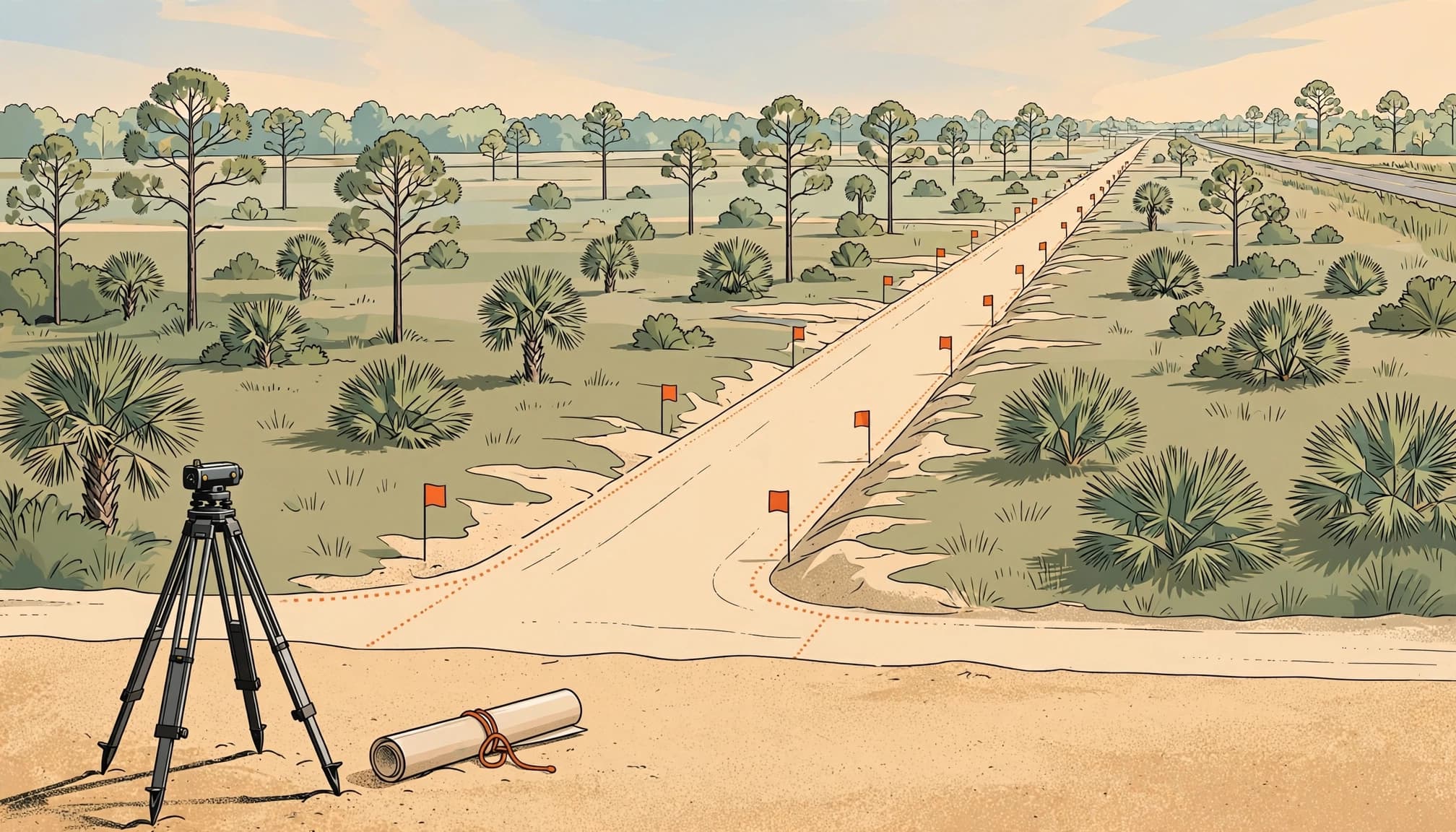
Find the parcel identification number through the county property appraiser, then compare the parcel map, plat maps, legal description, aerial view, and current survey. In Central Florida, county GIS records can help you spot whether the lot appears to touch a public street.
A parcel map is useful, but it is not a survey. GIS and aerial lines can be approximate and don’t establish property boundaries, especially on older rural tracts and irregular lots. A lot that appears connected may still be landlocked property without documented legal access.
Review Deeds, Plats, and Easements
Search the county Clerk of Court’s official records for the current deed, prior deeds, historical deeds, recorded plats, restrictions, and access documents. Check the relevant county or municipal zoning and permitting office to confirm whether an access route, driveway connection, or road improvement is allowed.
Look beyond the seller’s deed. Older subdivisions and rural parcels in Central Florida may require reviewing how one larger tract was divided, including any unity of title. An implied easement may provide context, but neither concept automatically establishes a current access right.
Read the legal description for each access right. Confirm its width, location, permitted use, maintenance duties, and whether it benefits your exact parcel.
A title commitment should identify any recorded easement as an exception affecting the specific parcel. Title insurance may address covered title risks, but it doesn’t prove that a physically usable route exists. If the access route doesn’t appear in the title documents, pause before closing.
Understand the Types of Easement Rights
Not every access right looks the same. The language in the deed and the parcel’s history matter.
Express, Implied, and Necessary Easements
An express easement is written and recorded. It is usually the clearest path because it identifies the properties, route, and permitted use.
An implied easement can arise from prior use when one owner divided land and an existing route was reasonably necessary for the new parcel. An implied easement analysis may depend on the property’s ownership history. Review historical deeds and confirm unity of title before relying on this theory. The Florida Bar’s discussion of implied easements from preexisting use explains why these records deserve close review.
Florida Statute Section 704.01 addresses an easement by necessity and a statutory easement in certain situations. These theories may require a fact-specific legal analysis. They don’t provide the same certainty as a recorded access document before closing.
Why a Prescriptive Easement Is Hard to Prove
A prescriptive easement involves using another owner’s land openly, visibly, continuously, uninterruptedly, and adversely for 20 years. The route also must be reasonably definite.
Friendly use doesn’t meet that standard, even when a dirt route has served neighbors in Central Florida. Neither does occasional use during hunting season, dry weather, or a neighbor’s informal approval. The Florida Bar’s review of prescriptive easement requirements shows why these claims need careful legal review.
Don’t buy a landlocked property based on the idea that you may later prove a 20-year use claim. Ask a Florida real estate attorney for Florida-specific review, and buy with confirmed rights whenever possible.
Resolve Missing Access Before Closing
When no recorded easement provides legal access, make resolution a written purchase-contract contingency. Require a signed and recorded access document before closing. An unrecorded promise, permission, or future agreement isn’t a substitute for confirmed rights.
Negotiate a Private Access Easement
A willing neighbor may be the fastest path to a solution. Begin neighbor negotiation with a survey-supported route that minimizes disruption to the neighboring property.
The parties should have an express easement drafted, signed, and recorded. A fair agreement should address:
- The exact width and location of the access corridor.
- Ingress and egress for owners, guests, contractors, utility vehicles, and emergency vehicles.
- Utility placement, road construction, drainage, gates, and future improvements.
- Who builds, maintains, insures, and repairs the access road and related features.
Compensation may be part of the agreement. Legal counsel can prepare language that is recorded and tied to both parcels.
Use the Right Professionals
A title company can identify recorded exceptions. A real estate attorney should review title, draft or approve the easement, and confirm that it binds the relevant parcels.
A licensed surveyor can locate the corridor on the ground. A civil engineer, county, or municipality may be needed to evaluate physical conditions, permitting, drainage, and road standards. In Central Florida, local requirements may affect whether a proposed route can support utilities, emergency access, or development.
Each role matters. A survey does not create legal access, and an attorney cannot confirm a route’s physical condition from a deed alone.
Confirm the Route on the Ground
A documented route must also work for a real build. A physical inspection tests whether it functions, but it doesn’t create legal access. Confirm that it reaches a public right of way, with enough width, stable ground, workable grades, proper drainage, and a connection local reviewers will accept.
Put the Recorded Corridor on a Survey
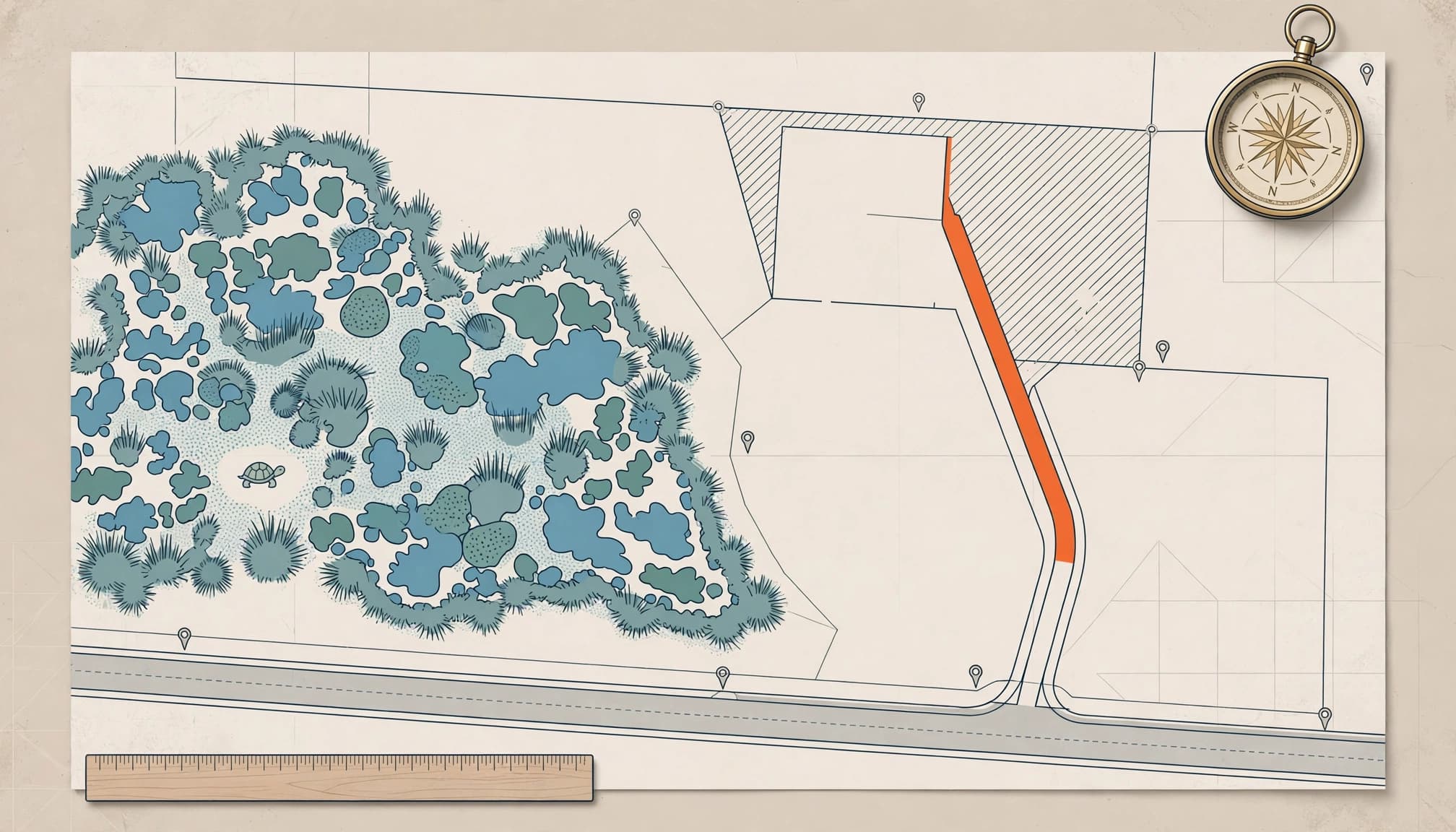
Order a current boundary survey and ask the surveyor to show the easement, lot lines, visible roads, land clearing, encroachments, and nearby improvements. A topographic survey may also be needed when the route crosses low ground or changes elevation. The survey shows physical conditions, but it doesn’t create an access right.
For a Southwest Florida or Central Florida build, survey information often connects to driveway design, drainage, finished-floor elevation, and utility planning. Charlotte County’s single-family permit process can require a signed and sealed survey, flood information, and elevation details. That county example isn’t a statewide rule, so confirm requirements with the local jurisdiction.
Check Width, Drainage, and Maintenance
A narrow access road may handle a passenger vehicle but create trouble for concrete trucks, emergency access, or utility installation. Check its width, grades, and drainage, and read the easement language before assuming the corridor can be widened or improved.
Before budgeting for land clearing to prepare the route, price grading, gravel, culverts, and other improvements. Forestry mulching may offer a lower-disturbance option in some areas, but it doesn’t authorize clearing, alter an easement, or replace surveys and permits.
Walk the route after rain if possible. Look for standing water, soft soil, culverts, swales, wetlands, and drainage easements. A dry route can look workable until summer rain arrives.
Also confirm who maintains the access road. An easement may grant use without requiring the neighboring owner to pay for grading, gravel, culverts, or repairs.
Check Environmental Limits Before Clearing
A cleared path is not always an approved access road. Florida lots can include wetlands, protected habitat, floodplain limits, mature trees, and drainage features that affect land clearing, route choice, and the budget.
Wetlands and Stormwater Need Early Review
The Florida Department of Environmental Protection’s Environmental Resource Permitting program covers many activities involving wetlands, surface waters, dredging, fill, stormwater, and land clearing. Depending on the project, environmental permits may involve FDEP, a water management district, or a delegated local government.
Don’t place fill or cut a road through a low area because it looks like the shortest route. A wetlands delineation may confirm the actual boundary, while forestry mulching may still require review near wetlands. Ask whether the crossing needs permits, engineered drainage, or a different alignment.
Protected Wildlife and Local Tree Rules
Gopher tortoises and their burrows are protected species in Florida. Before land clearing, check the FWC gopher tortoise permit guidance and arrange a qualified site review when habitat or burrows may be present.
Tree rules vary by location, including across Central Florida. Sarasota County, for example, identifies situations where a tree permit is required for removal, relocation, or injury to protected trees.
Forestry mulching can reduce disturbance near protected habitat, but it doesn’t replace site review. Land clearing or forestry mulching also can’t establish legal or recorded access, and neither replaces permits, environmental review, or a compliant road design that manages water properly.
Key Takeaways Before Making an Offer
A strong Florida lot purchase begins with a complete due-diligence file. Use this checklist before making an offer:
- Obtain and compare the deed, title search or title commitment, current boundary or topographic survey, and subdivision plat.
- Review county Clerk and property-appraiser public records, plus zoning and permitting information from the county or municipality.
- Confirm the recorded easement terms, public right of way or private-road ownership, and all road maintenance obligations.
- Verify the access road’s ownership, maintenance, width, drainage, and emergency access.
- Review flood, wetland, drainage, and utility information, including any land clearing or environmental requirements.
- Confirm that a visible driveway provides legal access. Otherwise, the lot could function as a landlocked property.
Your contract should allow time to review the title, survey, records, easements, zoning, and environmental conditions. Resolve defects in writing before closing. An easement-dependent purchase shouldn’t close until the document is acceptable, properly recorded, and tied to the correct parcels. This is especially important in Central Florida, where development conditions can vary between nearby properties.
For practical questions about how a lot may fit a home, driveway, and site-work plan, speak with a Southwest Florida builder after the property records are reviewed. For legal questions, consult the title company, a licensed surveyor, county or municipal staff, and a qualified Florida real estate attorney.
Frequently Asked Questions
Can a Neighbor Block a Recorded Easement?
A neighboring owner generally can’t ignore a valid recorded easement, but the answer depends on its wording and scope. The document may limit the route, width, vehicle types, improvements, gates, or maintenance responsibilities.
If an obstruction appears, preserve photos, survey information, the recorded instrument, and written communications. Have an attorney review the situation before taking action.
What Should a Surveyor Do for a Landlocked Lot?
A professional surveyor can identify property lines, locate a recorded easement corridor, and show visible improvements. A survey can also compare the legal route with conditions on the ground.
However, a survey doesn’t create legal access or prove that a route is publicly owned or maintained. It may reveal fences, sheds, drainage features, or encroachments affecting the route.
For a planned build, ask whether you also need topographic information and elevation data. In parts of Central Florida, those details can affect driveway grades, drainage, flood requirements, and site-work costs.
Build With Access, Not Assumptions
The right lot gives you more than a place to build. It gives you a documented route, legal access, a workable site plan, and fewer surprises after closing. A driveway, trail, or past use doesn’t replace documented rights.
Florida lot access should be confirmed before the purchase, not debated after the plans are complete. When title, survey, environmental review, and access-road feasibility support the property’s value, you can move forward with confidence. The same due-diligence standard applies to buyers in Central Florida.