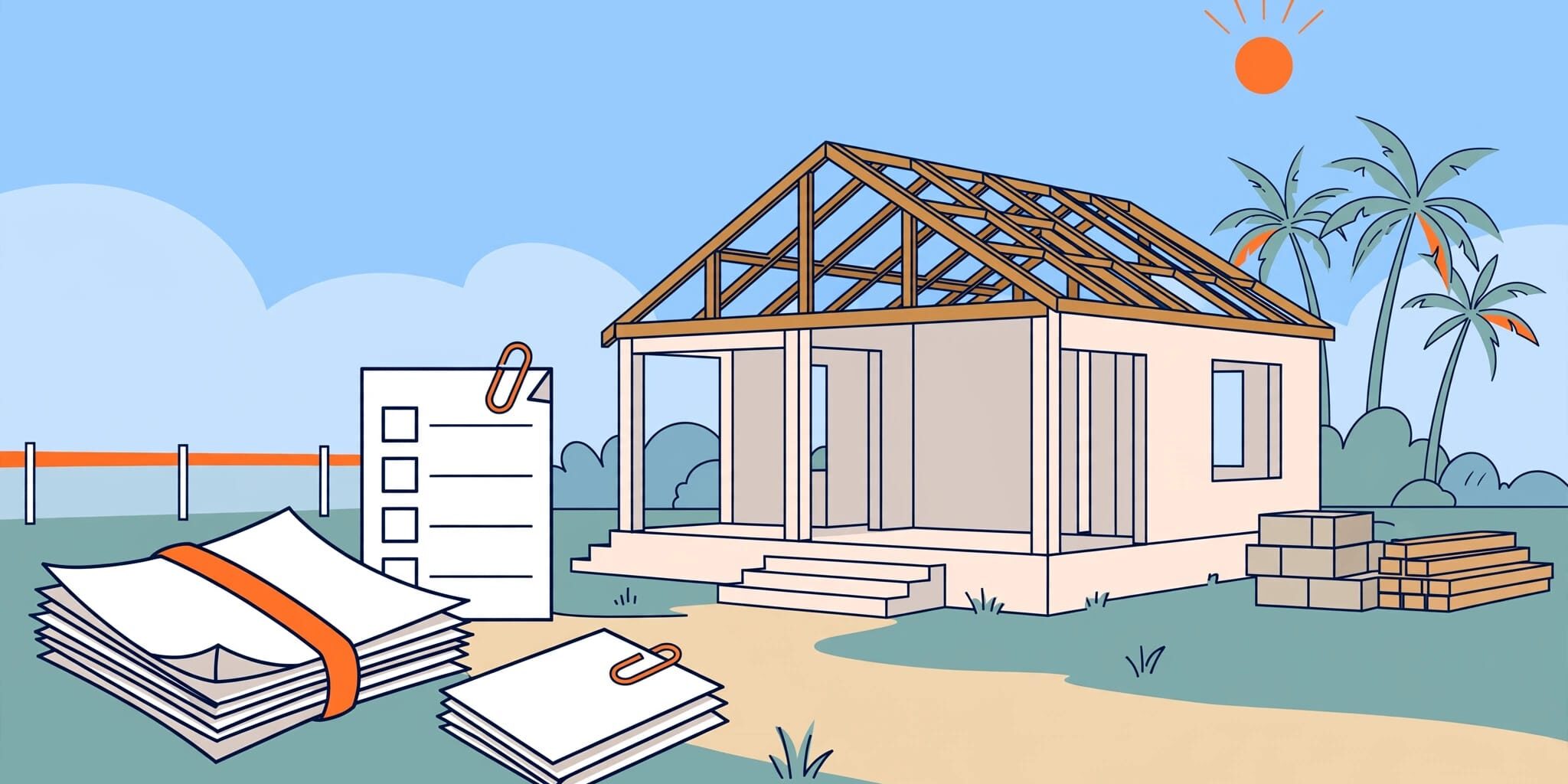
Your construction loan doesn’t arrive as one large payment. A construction loan draw schedule releases money as your home reaches approved building milestones.
We recommend matching those releases to your builder contract, verified work, and payment terms. That protects your cash flow and keeps expectations clear.
Milestones, lender requirements, and timing vary by lender, loan agreement, and project. Use the draw schedule to plan for inspections, paperwork, and the interest you’ll pay during construction.
Key Takeaways
- Most residential schedules use four to six draws tied to verified progress.
- Interest-only payments generally apply to money already disbursed, not the entire approved loan.
- Your loan documents and construction contract control equity contributions, retainage, change approvals, and final payment conditions.
What a Construction Loan Draw Schedule Covers
A draw schedule connects the construction budget to payment milestones. The builder submits a construction draw request after eligible work is complete. The lender orders a draw inspection to confirm verified progress before releasing funds.
Johnson Financial Group’s construction financing FAQs describe draws as portions of construction costs paid at stages of the build.
Match Payments to the Schedule of Values
The Schedule of Values, or SOV, breaks the approved budget into line items. Each request updates previous payments, current completed work, and the remaining balance.
Foundation, roofing, electrical, cabinets, and site work should have clear allocations. We recommend keeping those allocations consistent with the contract and specifications. Broad descriptions make payment disputes harder to resolve.
Understand What Counts as Completed Work
Under a work-in-place schedule, installed work qualifies for payment. A delivered crate of windows doesn’t complete the window installation line.
Some loans allow approved deposits or stored-material advances. These exceptions must follow the lender’s terms.
This process applies to borrower-funded construction. When a builder finances an inventory home, your purchase may instead use a standard mortgage near completion.
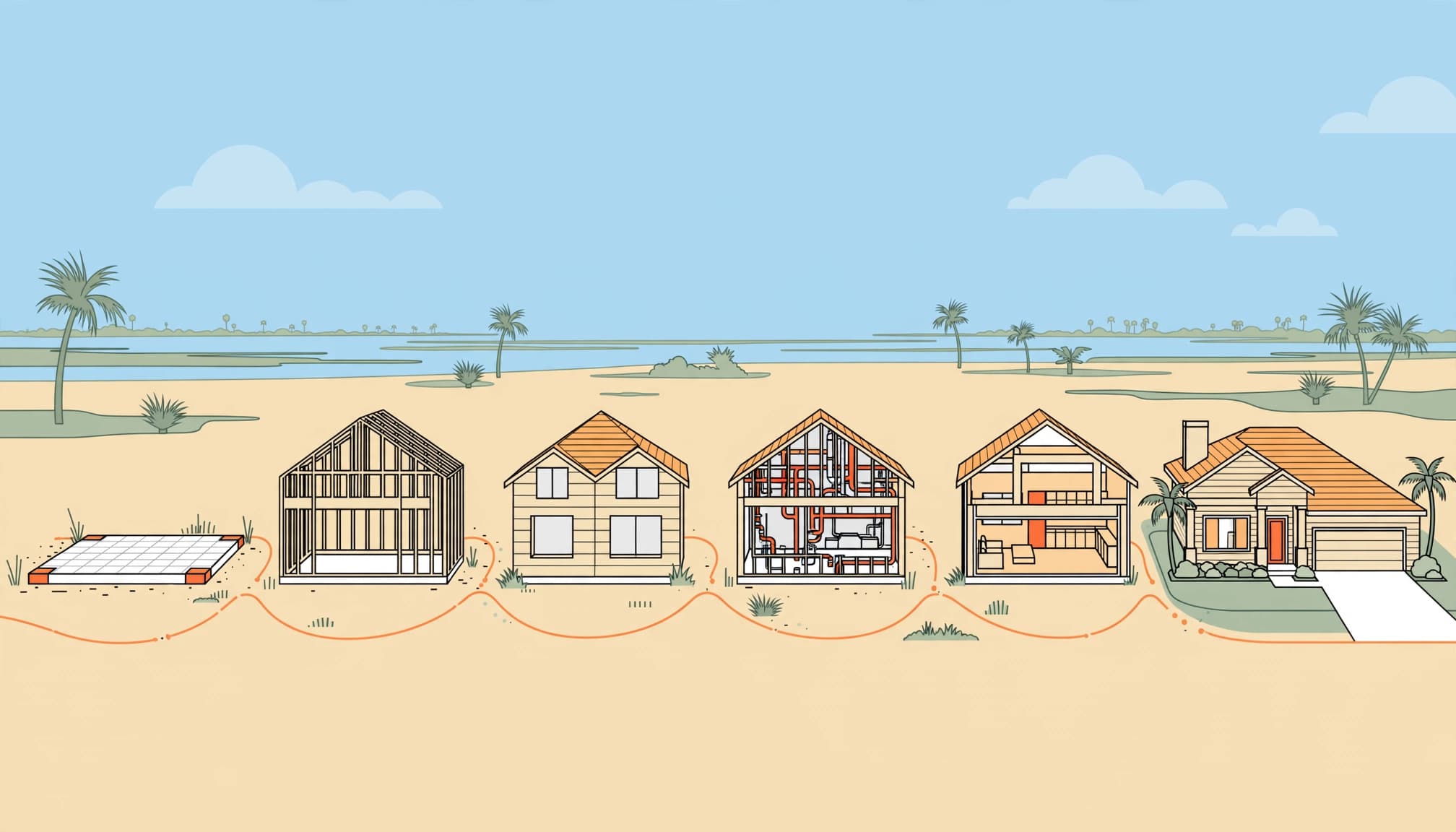
A Six-Draw Schedule for a $500,000 Build
Four to six draws are common for residential construction, but this six-draw example isn’t required for every Florida build. The lender, loan agreement, budget, and project determine the number of draws and their allocations. Larger custom homes, complicated sites, and longer projects can require more.
Common allocations are foundation at 15% to 20%, framing at 25% to 30%, dry-in and roofing at 10% to 15%, mechanical rough-in at 15% to 20%, and interior finishes at 15% to 20%. Final completion receives the remaining balance.
These ranges aren’t meant to add together at their maximums. Each milestone’s allocation must reflect actual costs, and all shares must total 100%.
This illustrative draw schedule uses $500,000 in financed construction costs and an 11% annual interest rate within a $500,000 construction budget.
| Milestone | Share | Draw Amount | Cumulative Drawn | Monthly Interest |
|---|---|---|---|---|
| Foundation | 15% | $75,000 | $75,000 | $688 |
| Framing | 25% | $125,000 | $200,000 | $1,833 |
| Dry-In and Roofing | 10% | $50,000 | $250,000 | $2,292 |
| Mechanical, Electrical, and Plumbing Rough-In | 20% | $100,000 | $350,000 | $3,208 |
| Interior Finishes | 20% | $100,000 | $450,000 | $4,125 |
| Final Completion and CO | 10% | $50,000 | $500,000 | $4,583 |
Interest figures assume each cumulative balance remains outstanding for a full month. The table excludes land, fees, equity contributions, and retainage.
The schedule should follow actual costs. Elevated foundations, drainage work, and utility connections can shift Florida spending toward earlier stages.
Calculate Interest Carry Before Construction Starts
Construction-stage payments are commonly interest-only. Bankrate’s construction loan explanation describes payments based on funds drawn to date.
The rate below is an example, not a current loan quote.
Calculate the Monthly Payment
For a monthly estimate, use:
Drawn balance × annual interest rate ÷ 12
At 11%, the first $75,000 draw produces $687.50 in monthly interest. Once the entire $500,000 is outstanding, that estimate becomes $4,583.33. This estimates interest-only charges on the balance disbursed.
Actual billing may use daily balances or other loan-specific methods. A midmonth draw won’t necessarily generate a full month’s interest.
We recommend budgeting for higher interest-only payments later in construction, when your balance is larger. Rent, insurance, inspection charges, and other expenses remain separate. An interest reserve may be available through approved financing, but its availability and terms depend on that financing.
Estimate the Total Build Period
Ledger’s worked example uses a $500,000 hard-cost budget over a nine-month linear build. Its roughly $20,600 interest estimate reflects an average outstanding balance near $250,000 at 11%.
The calculation is $250,000 × 11% × 9 ÷ 12, or $20,625.
Funding all $500,000 at closing would cost $41,250 over the same period.
That linear estimate isn’t the total of the six table rows. Actual interest depends on draw dates and balances. Delays extend interest carry. An interest reserve can cover payments when included in approved financing, but it remains part of the project cost.
How Draw Requests Move From Inspection to Funding
A complete package helps keep payments moving. We recommend organizing each request around the approved budget lines in your draw schedule and keeping prior payment records together.
Built’s draw request guide explains the formal submission used to request funds for completed work.
Prepare the Draw Package
Typical documentation includes:
- Submit the signed draw request with the requested amount and owner approval when required.
- Update the schedule of values (SOV) with prior draws, current completion, retainage, and remaining costs.
- Attach invoices and progress photographs tied to the requested budget lines.
- Include conditional lien waivers for the current payment and unconditional lien waivers for cleared prior payments, as required by Florida law and the lender.
- Provide relevant permits, inspection records, and approved change orders.
- Identify any title documentation or additional completion evidence required by the loan.
Florida’s statutory lien waiver rules govern applicable releases. A Florida construction attorney or qualified closing professional can review unclear documents.
Plan for Inspection and Release Time
The sequence is request, inspection, approval, then disbursement. Ledger describes inspections taking two to five business days, followed by funding two to three business days after approval. Groundfloor describes funding about 24 to 48 hours after approval.
These are provider examples, not Florida-wide deadlines. Timing varies by provider, lender, loan documents, and project. Package completeness, title issues, or unfinished work can also cause delays.
Draws of $250,000 or more may require a date-down title endorsement or an ownership-and-encumbrance report under some lender policies.
Allow roughly two weeks before a scheduled payment as a planning buffer, not a guarantee. Inspection approval alone doesn’t mean the wire has arrived.
Florida Permits and Changes Affect Draw Timing
Florida site conditions can affect the construction sequence and financing. Clear responsibilities help protect your budget before work begins.
Keep Permits and Inspections Separate
Florida’s building permit law requires the necessary permit before permitted construction begins. Under a reimbursement-based draw arrangement, permit fees may qualify after you obtain and document the permit. Permit, inspection, documentation, and written lender-approval requirements vary by jurisdiction, lender, loan agreement, and project.
A municipal inspection checks code compliance. A lender’s draw inspection verifies completed work for funding. A buyer inspection independently checks workmanship and contract requirements.
For coastal or flood-prone lots, foundation surveys, elevation documentation, fill, and drainage can affect early milestones. Assign each responsibility and due date in the construction documents.
Approve Changes Before the Work Begins
Each change order should identify scope, cost or credit, product specifications, allowance adjustments, and schedule effects. Get the required signatures before changed work starts. Update the construction budget to reflect each approved change.
Material changes also need written lender approval. Some lenders treat reallocations above 10% of a budget line as material, but that threshold isn’t universal.
A higher contract price doesn’t automatically increase the approved loan. Unfunded changes may require your own cash.
We recommend keeping contingency funds separate from planned upgrades. That leaves room for unexpected site costs without depending on an additional loan advance.
Understand Equity Contributions and Final Holdbacks
The milestone amount and the lender’s payment aren’t always the same. Equity requirements and retainage can change the cash available at each stage of the draw schedule.
Know Which Funds Pay First
With 100% lender disbursement, the lender funds eligible draws within the approved loan allocation.
A pro-rata arrangement divides each eligible draw between lender funds and borrower equity. A sequential arrangement, sometimes called LIFO in construction lending, requires borrower equity to be spent first.
Land equity may count toward the required contribution, but it doesn’t provide cash to pay trades. A schedule should show both total eligible work and the cash released.
Tie Final Payment to Written Completion Standards
Holdback or retainage commonly runs 5% to 10%, and Procore describes around 10% as typical. Amounts and release conditions depend on the contract and loan documents. Private Florida home builds don’t automatically follow the 5% retainage rule associated with certain public projects.
For example, a 10% holdback on $75,000 of eligible work leaves $67,500 available for current payment.
Release conditions may include the Certificate of Occupancy, final inspection, lien documents, and contractual completion.
A Certificate of Occupancy authorizes occupancy. It doesn’t establish that every punch-list item or contractual obligation is finished.
For an applicable direct construction contract, the contractor’s final payment affidavit addresses qualifying lienors and unpaid amounts. Final payment should also account for required lien waivers, utilities, warranties, and written punch-list commitments.
Frequently Asked Questions
What’s the Payment on a $200,000 Construction Loan?
At an illustrative 11% rate, a fully drawn $200,000 balance costs about $1,833 monthly in interest. A $50,000 drawn balance costs about $458.
Those estimates exclude fees, insurance, taxes, and principal repayment. The approved loan amount alone doesn’t determine the construction-stage payment.
Why Can an Approved Draw Be Delayed?
Approval may still be followed by title review, release processing, or bank transfer time. Missing lien documents, unmatched invoices, and unapproved changes can prevent a request from reaching final approval.
Completed work and complete paperwork both matter.
Does the Final Draw Automatically Start Permanent Financing?
The loan structure controls that transition. Construction-to-permanent financing may convert after required completion conditions are satisfied. A separate construction loan may require a new mortgage closing.
The final construction payment and permanent financing aren’t automatically the same event.
Build With Clear Payment Milestones
A reliable construction loan draw schedule connects completed work, documented costs, and available funding. We recommend treating interest carry and payment timing as part of affordability, alongside the construction price.
Clear milestones help you plan without assuming every inspection leads to immediate payment.
If you’re planning a home in Lee, Charlotte, or Highlands County, discuss your construction plans with our team. We can help you connect the scope and budget before you take the next step with financing.