
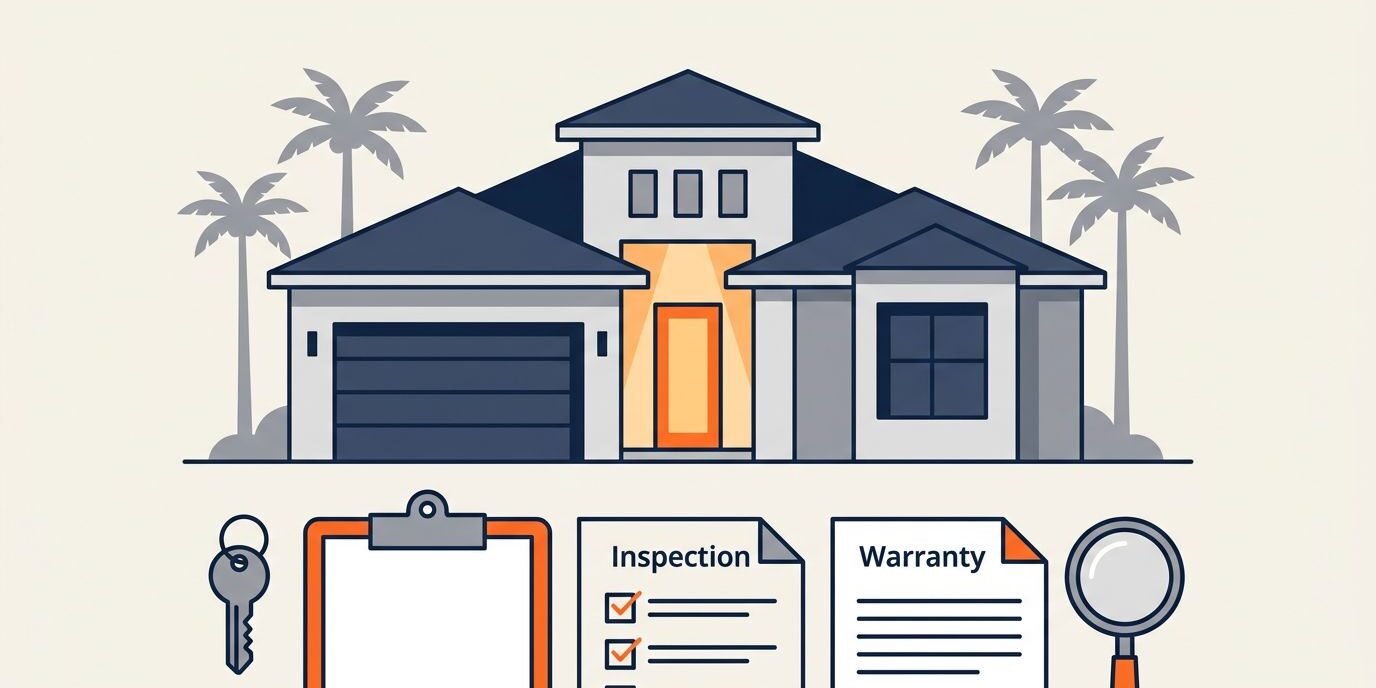
A newly constructed home should come with confidence, not a stack of unanswered repair questions. Yet a search for Florida new-home warranty information can mix builder obligations, appliance plans, and sales offers as if they are the same thing.
They aren’t. Florida’s one-year builder warranty is a legal minimum for qualifying new construction. A home service contract is optional protection with its own fees, limits, and exclusions.
We recommend getting clear answers before closing, while the builder, plans, and construction records are still easy to reach.
Key Takeaways
- Florida’s statutory warranty for qualifying new construction lasts one year from the earlier of the first owner’s title conveyance or the home’s initial occupancy.
- The required builder warranty generally addresses construction defects that cause a material violation of the Florida Building Code, not routine maintenance, normal wear, or every cosmetic issue.
- Builder warranties, manufacturer warranties, and optional home service contracts provide different protections, fees, exclusions, and coverage limits.
- Before closing, obtain the written warranty, confirm the start date and repair-notice process, and complete detailed inspections and a documented punch list.
- Report potential defects in writing with photographs, exact locations, requested corrections, and copies of all related records.
New Home Warranty Florida Questions, Answered
For buyers, the first question is usually: “What protection comes with this house?” Since July 1, 2025, Florida law has required builders to provide a statutory home warranty for a qualifying newly constructed home. The minimum protection is tied to a material violation of the Florida Building Code. Its coverage limits mean it isn’t a general maintenance plan. You can review the full requirements in Florida Statutes Section 553.837.
Which Homes Are Included
The law applies to new single-family homes, duplexes, triplexes, and quadplexes that have not been previously occupied. It can also apply to certain modular, manufactured, and factory-built homes that meet the statutory definition.
A builder may offer a separate structural warranty covering load-bearing elements. Buyers shouldn’t assume the statutory protection automatically covers every structural issue.
That matters for families, renters turned buyers, and investors. A duplex purchase deserves the same careful review as a single-family home. Inspect both sides, shared systems, exterior finishes, roof areas, garages, and utility connections.
When the One-Year Clock Starts
The warranty lasts one year from the earlier of two events: the original conveyance of title to the first owner or the home’s initial occupancy.
The builder must address a covered defect at its expense and restore work damaged during the repair. The obligation continues for the full year even if the original owner sells the property.
Confirm the exact start date in writing. Ask whether the builder’s express written warranty meets or supplements the statutory minimum. Don’t assume every builder document expands coverage.
What a Covered Construction Defect Looks Like
A statutory home warranty is not a general repair list. It covers construction defects involving workmanship and materials provided by the builder, subcontractor, or supplier when the issue causes a material violation of the Florida Building Code.
Those coverage limits are narrower than many buyers expect. The statute addresses code-related problems, not every cosmetic concern that appears after move-in.
A Code Violation Must Be Material
A loose cabinet pull and a major water-intrusion concern aren’t in the same category. Issues involving flashing, plumbing support, duct connections, exterior penetrations, or electrical protection need careful documentation and a clear explanation.
For roof leak repairs, a flashing or penetration defect may warrant investigation. The underlying code-related defect, not simply the presence of a leak, controls the analysis. Foundation movement, framing concerns, or issues involving load-bearing elements may also need closer review. A separately labeled structural warranty may have its own terms, so don’t treat it as identical to the statutory standard.
Take photographs. Record the room and exact location. Keep relevant plan pages, inspection reports, and emails together. A Florida statutory warranty overview can help explain why the Building Code connection matters.
Common Exclusions to Expect
The required builder warranty does not cover everything that breaks or changes over time. Common exclusions include:
- Appliances or equipment covered by a separate manufacturer warranty.
- Normal wear and tear from regular use.
- Normal house settling within accepted trade practices.
- Damage caused by an owner, later purchaser, or outside party.
- Losses from an act of God, such as a natural disaster or lightning-caused fire.
A crack, stain, or uneven surface may still deserve attention. The key is to separate a cosmetic correction, maintenance issue, manufacturer claim, and potential statutory defect.
Builder Warranties and Service Contracts Are Different
Many new home warranty Florida searches bring up optional service contracts from home warranty companies. These plans can help with later system or appliance failures, but they don’t replace the builder’s legal responsibility for covered construction defects.
A builder may meet Florida’s requirement through the statutory warranty, an express written warranty that meets or exceeds minimum terms, or coverage backed by a Chapter 634 home warranty association. A separately promised structural warranty may also appear in the contract, so verify its scope.
Compare the Protections Before Paying
These protections have different jobs, so compare the written terms before paying.
| Protection | Main Purpose | What to Verify |
|---|---|---|
| Statutory builder warranty | Material Building Code violations in new construction | Start date and written notice process |
| Manufacturer warranty | New appliances and installed equipment | Registration, term, and service contact |
| Home service contract | Eligible later system or appliance failures | service fee, coverage limits, and contractor network |
The legal warranty requirement and optional service-plan shopping are separate issues, as explained in 2-10’s HB 623 overview. Review an express written warranty for its start date, notice rules, and scope before relying on it.
Price and Add-On Questions Matter
Current Florida service-contract pricing from home warranty companies often falls around $42 to $74 per month. The monthly premium varies by address, home age, plan level, and add-ons.
A service fee commonly ranges from $75 to $125 per claim. Compare that service fee with the plan’s coverage limits, including caps and exclusions, before choosing a contract. Read the coverage limits for major systems and appliances, even when the monthly premium appears low.
Advertised starting prices may include $29.99 from American Home Shield and about $32 from 2-10 Home Buyers Warranty. First American Home Warranty and Select Home Warranty may show different starting rates. Prices change and aren’t endorsements, so request current written quotes before signing. Verify add-on terms with American Home Shield and First American Home Warranty. Check the same details with Select Home Warranty and 2-10 Home Buyers Warranty.
Pool and spa coverage often costs extra, and plans may advertise roof leak repairs or pool equipment as add-ons. Check whether roof leak repairs apply to the covered equipment, and review the waiting period and caps. Read the exclusions carefully before relying on any advertised benefit.
Read the Written Warranty Before You Close
Florida law creates a minimum protection. Before closing, obtain the written home builders warranty and review its coverage limits. Your purchase contract and express written warranty explain how repairs are reported, reviewed, scheduled, and completed.
Don’t accept a vague answer like, “Call us if something comes up.” Ask for that document before closing and save a digital copy with your contract, selections, permits, and final inspection records.
Confirm the Repair Process
A strong written warranty identifies who receives notice, how you should submit a claim, how repairs are scheduled, and what happens if access is needed inside the home.
Ask one practical question: if a covered repair damages drywall, flooring, paint, or another finished surface, who restores that work? Under the statute, the builder must correct a covered defect and restore work damaged during the repair.
If any warranty language seems unclear, ask for a written explanation. Clear records prevent a verbal promise from disappearing later.
Keep Product Warranties Separate
Your refrigerator, range, water heater, air-conditioning equipment, garage-door opener, and other products may carry separate warranties from their manufacturers. Optional service contracts from American Home Shield, First American Home Warranty, and Select Home Warranty are separate from a product’s manufacturer warranty and may charge a service fee.
Review each plan’s coverage limits separately from the builder’s legal obligations. A plan advertising roof leak repairs may have separate exclusions or caps.
Register eligible products soon after closing. Keep serial numbers, receipts, manuals, model information, and service records in one folder. If an appliance stops working, you will know whether to contact the builder, manufacturer, installer, or service-contract provider.
Build a Punch List That Gets Results
A good punch list is more than a page of notes. It creates a clear record and gives the builder a fair chance to correct open work before final sign-off.
We recommend using phase inspections when your contract allows them. They’re especially valuable in a newly constructed home. A city inspection and certificate of occupancy are important, but they don’t replace your own detailed review.
Use Phase Inspections Wisely
A pre-pour inspection can identify visible concerns before concrete covers them. Check forms, reinforcement, load-bearing elements, vapor barriers, under-slab plumbing, utility penetrations, and planned elevations against the approved documents.
A pre-drywall inspection lets you review visible distribution systems, including plumbing, electrical wiring, HVAC components, insulation, ducts, and condensate-drain routing, before walls close. At the final walk-through, focus on moisture protection, roof flashing, exterior caulking, grading, penetrations, and signs that could require roof leak repairs. Check doors, cabinets, tile, paint, screens, and fixture operation.
If access to a pre-drywall inspection is denied, ask for that policy in writing. Your contract controls many inspection and closing rights.
Make Every Entry Actionable
Document every observable concern first, then sort out coverage limits and the responsible warranty or plan later. Each punch-list item should include:
- The room and exact location of the concern.
- A clear photograph or short video.
- The requested correction and responsible trade.
- A target completion date and written response.
Water issues should move to the top of the list. Poor grading, open penetrations, damaged stucco, missing caulking, and improperly routed condensate lines can create larger repairs if they remain open.
Don’t sign a document saying all defects are corrected when known items remain. A reinspection is a reasonable way to confirm the work is complete.
What to Do When a Defect Appears
When a defect appears in a newly constructed home, start with clear written notice. Include the property address, discovery date, exact location, photographs, a plain description, and your requested repair.
Send the notice using the method listed in the express written warranty. Keep copies of emails, texts, certified-mail receipts, reports, invoices, and responses.
Builder obligations come from the written warranty, while optional plans from home warranty companies may differ. American Home Shield, First American Home Warranty, Select Home Warranty, and 2-10 Home Buyers Warranty may use different portals, contractor assignment procedures, and terms.
Before filing an optional-plan claim, review the plan’s coverage limits. Record its service fee before a contractor is dispatched. Check coverage limits, exclusions, and caps before approving the assigned work. Confirm that the specific repair qualifies under coverage limits, and verify the service fee before authorizing a later visit.
Give Clear Written Notice
If the builder disagrees with your concern, request the exact plan detail, warranty term, specification, or Florida Building Code section supporting that position. This keeps the discussion focused on facts.
For a serious concern involving load-bearing elements, review the structural warranty and seek appropriate advice. Report problems requiring roof leak repairs promptly, especially when delay could cause more damage.
A summary of Florida builder warranty requirements explains that purchasers may have a private right of action when a builder doesn’t comply, depending on the facts. For a major repair dispute, safety concern, or substantial cost, speak with the appropriate Florida-licensed professional before signing away rights.
Keep the First Year Organized
Set calendar reminders before the one-year deadline. Review the home after heavy rain, during hot weather when the HVAC works hardest, and after using every plumbing fixture, outlet, appliance, and exterior feature.
Investors should keep the same records. The statutory obligation continues through the first year even if the home transfers to a new owner. Good documentation supports repairs, resale questions, insurance needs, and future maintenance.
Frequently Asked Questions
What does Florida’s new home warranty cover?
Florida’s statutory warranty generally covers construction defects involving builder-provided workmanship or materials when they cause a material violation of the Florida Building Code. It is not a general maintenance plan and may not cover normal wear, settling, cosmetic concerns, or owner-caused damage.
When does the one-year Florida builder warranty begin?
The warranty begins on the earlier of the original conveyance of title to the first owner or the home’s initial occupancy. Confirm the exact date in the written warranty and keep it with your closing records.
Is a home service contract the same as a builder warranty?
No. A builder warranty addresses qualifying construction defects, while an optional home service contract may help with eligible later failures of covered systems or appliances and usually has service fees, limits, and exclusions.
What should I ask the builder before closing?
Request the complete written warranty and confirm its coverage, start date, notice procedure, repair schedule, and responsibility for restoring finishes damaged during covered work. Also ask for inspection access, product-warranty information, and copies of relevant construction records.
What should I do when I find a defect after closing?
Give written notice using the method required by the warranty, including the property address, discovery date, exact location, photographs, and requested repair. Keep copies of all communications, reports, receipts, and responses, and seek appropriate professional advice for serious structural, safety, or costly concerns.
A Strong Start to Homeownership
A new home warranty is strongest when you understand its limits and keep a written record of every concern. Know when the one-year period begins, separate builder coverage from product warranties, and treat optional service contracts as a separate purchase.
You should not have to rely on vague promises when clear documents, photographs, and follow-up can protect your home and budget. Keep the builder’s express written warranty, inspection records, and repair correspondence together.
When comparing home warranty companies, weigh the monthly premium, service fee, and coverage limits for options such as First American Home Warranty and Select Home Warranty, rather than relying on an advertised price alone.
If you are planning a new home in Southwest Florida, get in touch about your new home warranty questions before closing.